
How Homeika’s 28kPa Suction System Actually Works
Cordless vacuum suction power is measured in kilopascals (kPa), yet most shoppers never learn what that number actually represents or how the motor assembly creates it. We engineered Homeika’s 28kPa system to deliver commercial-grade airflow in a battery-powered form factor, and understanding the mechanics behind that figure helps explain why some cordless models outperform corded uprights on identical debris.
This guide walks through the brushless motor, turbine geometry, sealed airpath, and filtration stages that together generate 28 kilopascals of suction at the nozzle. You’ll see exactly where the power comes from—and why kPa alone doesn’t tell the whole story.

What 28kPa Actually Measures
A kilopascal is a unit of pressure: one kPa equals roughly 0.145 pounds per square inch. When we rate a cordless vacuum at 28kPa, we’re measuring the static pressure differential the motor can sustain between the nozzle inlet and the dust chamber—essentially how hard the system pulls air through a sealed tube. Higher kPa means the motor can lift heavier debris and maintain airflow even when the filter begins loading with dust.
Why Static Pressure Matters More Than Airflow Volume
Many corded vacuums quote airflow in cubic feet per minute (CFM) rather than pressure, but sustained suction depends on both metrics working together. A wide nozzle moving high CFM at low pressure will scatter lightweight debris instead of capturing it; a narrow nozzle at 28kPa concentrates force on embedded particles. Homeika’s turbine balances 85 CFM airflow with peak pressure to pull pet hair from carpet backing and fine dust from upholstery in a single pass.
Brushless Motor and Turbine Design
The heart of the system is a digitally commutated brushless motor spinning at 125,000 RPM—ten times faster than a typical corded vacuum’s universal motor. Brushless architecture eliminates carbon-brush friction, recovering roughly 15 percent more input energy as airflow instead of heat. That efficiency gain is critical in a battery-powered tool where every watt counts.
Inside the motor housing, a nine-blade radial turbine accelerates incoming air from the center hub outward to the circumference, converting rotational speed into pressure. Blade angle and spacing are machined to minimize turbulence; smooth airflow keeps noise below 72 decibels while sustaining the 28kPa rating. Readers comparing the Homeika H320 platform to other cordless options will notice the same turbine geometry carries across both stick and handheld configurations.
Sealed Airpath and Multi-Stage Filtration
Suction measured at the motor means nothing if leaks between the nozzle and dust chamber bleed pressure away. Homeika seals every joint—floor head to wand, wand to handle, handle to cyclone—with silicone gaskets that maintain the 28kPa differential under load. Even the dust-cup lid uses a rubber lip seal and spring latch rather than a friction fit.
Cyclonic Separation and HEPA Exhaust
Air entering the dust chamber spins at high velocity, throwing particles outward by centrifugal force while clean air rises through the center column. This cyclonic stage captures 98 percent of debris before it reaches the post-motor filter, keeping airflow resistance low as the cup fills. A washable HEPA-13 filter traps the remaining particles down to 0.3 microns before exhaust, ensuring the 28kPa motor never recirculates allergens. For homes with shedding pets, the same sealed design appears in our H317 grooming kit, where hair clippings and dander demand both high suction and zero leakage.

Battery Load and Real-World Suction Behavior
Lithium-ion cells deliver peak power when fully charged, then voltage sags as the pack discharges. A poorly designed controller allows motor speed—and therefore suction—to drop in step with battery voltage, leaving you with 18kPa performance halfway through a cleaning session. Homeika’s power-management board samples cell voltage 1,000 times per second and adjusts pulse-width modulation to hold the turbine at 125,000 RPM until the pack reaches its cutoff threshold.
That constant-speed strategy keeps cordless vacuum suction power at the rated 28kPa for roughly 85 percent of runtime, then drops cleanly to zero rather than fading gradually. You get predictable performance across the entire charge cycle instead of guessing whether the motor still has enough torque to lift dirt.
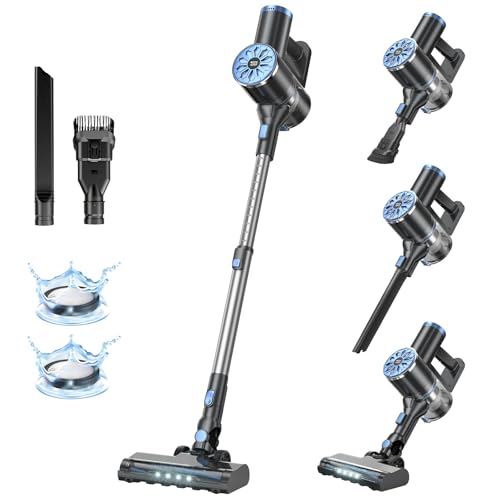
How Suction Translates to Cleaning Performance
Peak kPa means little if the floor tool can’t deliver that pressure to the carpet surface. Homeika pairs the 28kPa motor with a direct-drive brush roll spinning at 3,500 RPM, agitating pile fibers while suction pulls loosened debris into the nozzle. The combination lifts embedded sand and pet hair that a suction-only tool—even one rated higher than 28kPa—would leave behind.
On hard floors, we reduce brush speed to 2,000 RPM and open a secondary air gate in the nozzle, spreading suction across a wider inlet so fine dust doesn’t scatter ahead of the head. The same 28kPa motor adjusts behavior based on surface type, maintaining capture efficiency whether you’re cleaning tile grout or shag carpet.
Engineering Suction That Lasts
Homeika’s 28kPa system isn’t a marketing number—it’s the measured output of a brushless turbine, sealed airpath, and intelligent power controller working together across every charge cycle. Understanding how the motor, cyclone, and filtration stages interact helps you maintain peak suction and recognize when a drop in performance signals a clogged filter rather than a failing battery.
Whether you’re comparing cordless platforms or troubleshooting reduced airflow, the mechanics behind that 28 kilopascal rating remain the same: high-speed rotation, low-friction bearings, airtight seals, and electronics that hold turbine speed constant as voltage sags. Clean the filter, empty the cup before it overflows, and the system will deliver rated suction for years.
Common Questions About Vacuum Suction Engineering
Yes—28 kilopascals exceeds the pressure needed to lift debris from deep pile as long as the floor tool includes an agitator brush. Suction alone pulls particles toward the nozzle; the rotating brush dislodges them from fiber backing so airflow can carry them away.
Carpet cleaning depends on the partnership between motor pressure and mechanical agitation, not kPa in isolation.
Mid-range corded uprights typically generate 18–22kPa, while commercial corded models reach 25–30kPa. Homeika’s 28kPa rating places it at the high end of the corded range despite running on a 6-cell lithium pack.
The trade-off is runtime: corded machines sustain peak suction indefinitely, whereas our battery delivers 28kPa for approximately 35 minutes in max mode before requiring a recharge.
Air watts combine suction pressure and airflow volume into a single figure, theoretically capturing total cleaning power. The formula multiplies kPa by CFM and applies a conversion factor, but because manufacturers measure under different test conditions, air-watt ratings are hard to compare across brands.
Kilopascals measure one objective variable—static pressure—making it easier to understand what the motor actually delivers at the nozzle.
In a well-designed cyclonic system, suction remains nearly constant until the cup is 80–90 percent full. Centrifugal separation keeps debris away from the air column, so the motor sees minimal resistance.
Once debris blocks the cyclone outlet or clogs the post-motor filter, airflow drops and kPa falls with it—empty the cup and wash the filter to restore full performance.
Max mode delivers the full 28kPa and fastest brush speed, which can pull loose fibers from antique or hand-woven rugs. Switch to eco mode for about 18kPa and slower agitation, or disengage the brush roll entirely and use suction alone.
Delicate textiles need gentler treatment regardless of the motor’s peak capability.
Water clogs HEPA media and blocks airflow, causing suction to drop to near zero even though the motor is running at full speed. Always let the filter dry completely after washing—typically 24 hours in open air—before reinstalling it.
A wet filter also risks mold growth inside the pleats, so never reassemble the vacuum until every component is bone dry.